Use Case: Compressing OSHA Audit Prep from Days to Hours
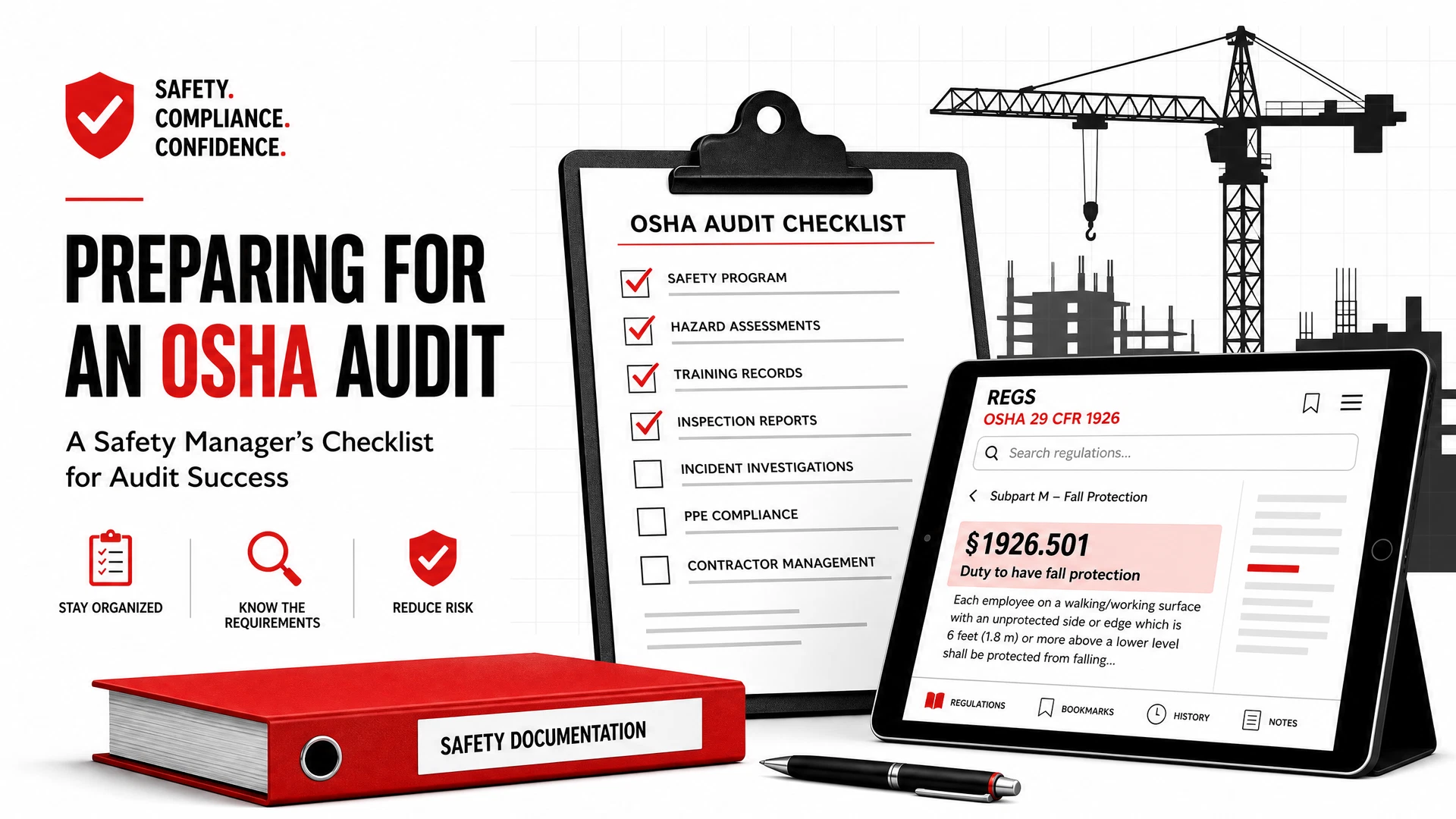
This walkthrough is an illustrative use case showing how RegLogic fits a real-world audit-prep workflow in commercial construction.
Picture the situation every construction safety manager knows: an OSHA inspection is likely — maybe a programmed inspection under a local emphasis program, maybe a follow-up. The traditional prep cycle means pulling the 1926 book, cross-referencing company programs against current standards, and hoping the edition on the shelf is current. That process routinely eats two to three days.
The RegLogic Workflow
- 1. Start with the top-cited standards. Fall protection (1926.501), ladders (1926.1053), and scaffolding (1926.451) lead OSHA's citation list year after year. Search each one and review the current text — not the text from the last printed edition.
- 2. Verify programs against exact provisions. Written fall protection plans get checked against §1926.502 criteria clause by clause, with the color-coded hierarchy making exceptions and notes impossible to miss.
- 3. Pull Letters of Interpretation. Where a requirement is ambiguous — say, anchorage requirements on a leading edge — LOIs linked to the standard show how OSHA itself has interpreted the rule.
- 4. Brief the field offline. Superintendents get the relevant sections on their phones through offline access — no signal required at the laydown yard.
Why This Matters
OSHA's maximum penalty for a serious violation now exceeds $16,000 per item, and willful or repeated violations run past $165,000. An audit-prep process that verifies against current text — rather than a possibly outdated book — directly reduces exposure. The time saved is real, but the accuracy is the point: when the compliance officer cites a provision, the safety manager is reading the same current text the officer is.
The result: preparation that used to consume days compresses into hours, documentation cites exact current provisions, and the field crew walks into inspection day already briefed.