Regulation library · CFR 101
How to read the operating system of federal law.
Every OSHA standard, hazmat rule, and trucking regulation lives inside the Code of Federal Regulations — a 50-title codification of everything federal agencies require. Understanding its structure makes every citation legible.
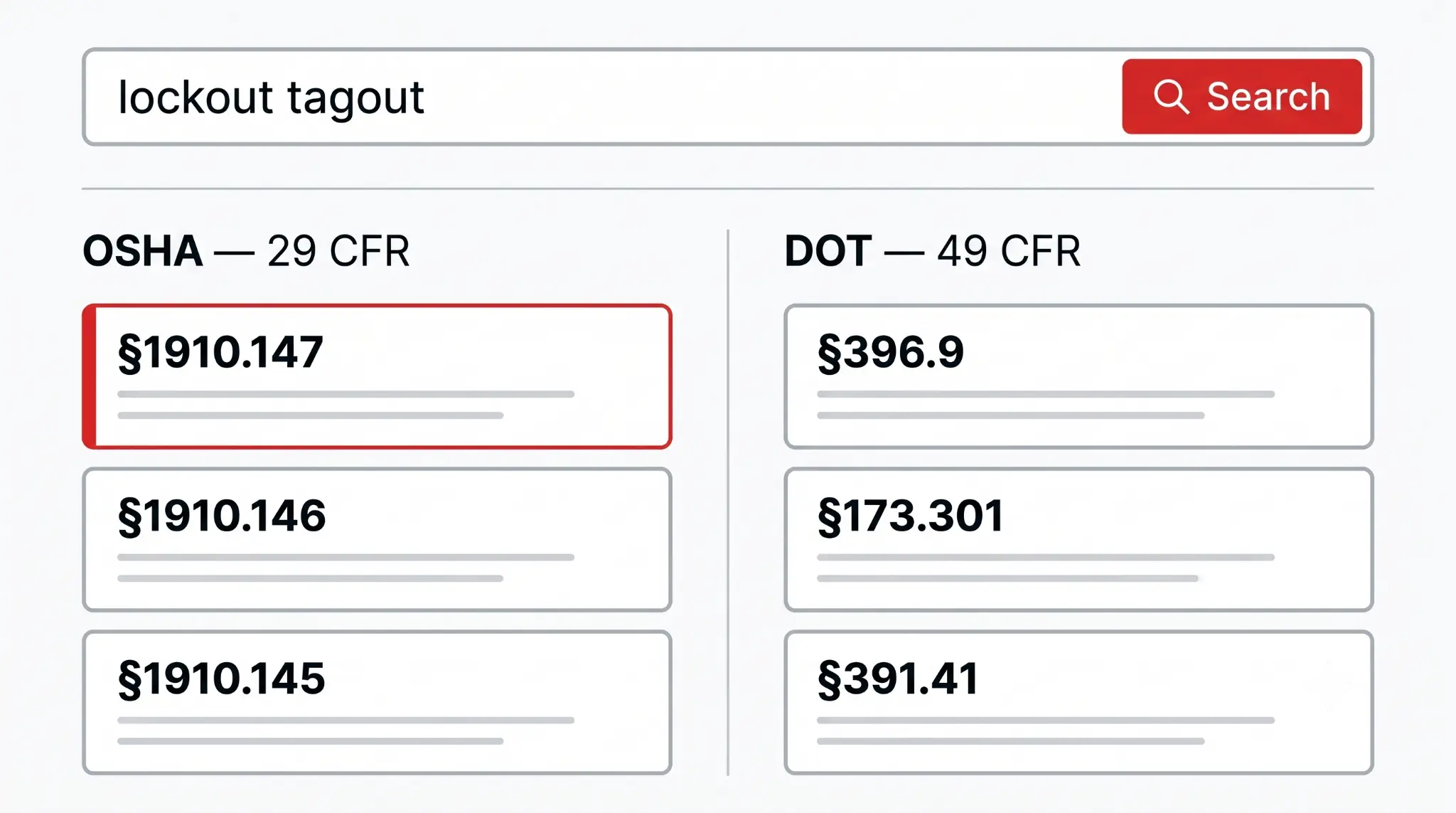
Key sections at a glance
Title 29
Labor — OSHA standards
Title 49
Transportation — DOT rules
Part
Subject area (e.g., 1910)
Section
Individual standard (e.g., .147)
(a)(1)(i)(A)
Nested paragraph levels
The structure: title → part → section → paragraph
The CFR is organized into 50 titles by subject. Title 29 is Labor, home of OSHA; Title 49 is Transportation, home of DOT's hazmat, motor carrier, and pipeline rules. Titles divide into parts (29 CFR Part 1910 is General Industry), parts into sections (§1910.147 is Lockout/Tagout), and sections into a nested outline of paragraphs: (a), then (1), then (i), then (A).
So 29 CFR 1910.147(c)(4)(ii)(B) reads as: Title 29, Part 1910, Section 147, paragraph (c)(4)(ii)(B) — a precise address for one requirement inside a document the size of an encyclopedia. Once the addressing scheme clicks, every citation in an OSHA citation packet, insurance audit, or contract spec becomes navigable.
How rules get into the CFR
Congress passes statutes (like the OSH Act of 1970) that authorize agencies to regulate. Agencies then make rules through notice-and-comment rulemaking, publishing proposals and final rules in the daily Federal Register. Final rules are codified into the CFR, which is why the CFR is always in motion — amendments, corrections, and new incorporations land throughout the year, and the "current" CFR is really a continuously amended text.
That's the trap with print editions and with any digital copy that isn't actively maintained: the official annual print revision of a CFR title is a snapshot, superseded by every Federal Register amendment after its cut-off date.
Where RegLogic fits
RegLogic presents CFR text in patented color-coded outline formatting that makes the nested paragraph structure visible, updates the day amendments publish, and layers plain-language search plus Letters of Interpretation on top. Mancomm has published CFR content in print since 1994 — RegLogic is that editorial practice, running continuously.
What does CFR stand for?
CFR stands for Code of Federal Regulations — the official compilation of all permanent rules published by federal agencies in the United States. It is organized into 50 titles covering different areas of federal regulation. Title 29 covers Labor (including OSHA), Title 49 covers Transportation (including hazmat), and Title 40 covers Environmental Protection.
The CFR is updated annually on a rolling basis. Between annual revisions, changes are published daily in the Federal Register. RegLogic reflects changes same-day without waiting for the annual revision cycle.
Is OSHA state or federal?
OSHA is a federal agency within the U.S. Department of Labor. However, 22 states operate their own OSHA-approved state plans that can adopt stricter standards. Examples include Cal/OSHA (California), MIOSHA (Michigan), and TOSHA (Tennessee).
In states without approved plans, federal OSHA directly enforces workplace safety standards. RegLogic covers the federal CFR standards that form the baseline for all state plans.
CFR vs. USC: what is the difference?
The United States Code (USC) contains laws passed by Congress. The Code of Federal Regulations (CFR) contains rules that agencies write to implement those laws. The OSH Act (29 USC 651) created OSHA; 29 CFR Parts 1900-1999 are the specific safety standards OSHA wrote under that authority.
When you need to know what a regulation requires, you look in the CFR. When you need to know what authority the agency has, you look in the USC. RegLogic covers the CFR — the operational rules that govern daily compliance.
Read The CFR, Explained — searchable, color-coded, always current — in RegLogic.
Start HereFAQ
Common questions
What's the difference between the CFR and the Federal Register?
The Federal Register is the daily journal where proposed and final rules publish; the CFR is the organized codification of the rules currently in force. A final rule appears in the Federal Register first, then is codified into the CFR.
Is the eCFR the official version?
The eCFR is an up-to-date editorial compilation maintained by the government; the annually revised print CFR volumes remain the official legal edition. For practical compliance work, currency matters more than format — which is why same-day updating is central to RegLogic.
How do I read a citation like 29 CFR 1910.147(c)(4)?
Title 29 (Labor), Part 1910 (General Industry), Section 147 (Lockout/Tagout), paragraph (c)(4) (the energy control procedure requirement). Title, part, section, paragraph — in that order, every time.
What does CFR stand for?
Code of Federal Regulations — the official compilation of all permanent rules published by U.S. federal agencies, organized into 50 titles by subject area.
What does CFR stand for in law?
In legal context, CFR refers to the Code of Federal Regulations — the regulatory counterpart to the United States Code (USC). The USC contains statutes; the CFR contains regulations.
Is OSHA state or federal?
OSHA is a federal agency, but 22 states operate their own OSHA-approved state plans. Federal OSHA sets the minimum; state plans can be stricter.
How many titles are in the CFR?
50 titles, each covering a broad subject area. Title 29 (Labor) contains OSHA, Title 49 (Transportation) contains hazmat rules, Title 40 contains EPA regulations.
Get regulation updates that matter
Join safety pros getting enforcement trends, standard changes, and practical compliance guidance. No spam.