Regulation library · LOIs
The regulation tells you the rule. LOIs tell you how OSHA enforces it.
When employers ask OSHA how a standard applies to a specific situation, the agency answers in writing. Those answers — Letters of Interpretation — are the closest thing to reading the inspector's mind, and almost nobody uses them.
What a Letter of Interpretation is
An LOI is OSHA's official written response to a question about how a standard applies to a particular set of facts. The letters don't create new law — OSHA is careful to say they explain existing requirements — but they document exactly how the agency reads its own text: whether a warehouse mezzanine needs guardrails, when maintenance becomes construction, what counts as "residential construction" for fall protection options, whether a specific respirator practice satisfies §1910.134.
Because they respond to real scenarios from real employers, LOIs answer precisely the kind of edge-case questions the regulation text leaves open — which makes them decisive in citation contests, informal conferences, and internal debates about whether a practice is defensible.
Why almost nobody reads them
OSHA has published thousands of interpretation letters, hosted on OSHA.gov in a search interface that's separate from the standards themselves. Finding the letters relevant to a given paragraph means knowing they exist, searching the right terms, and reading letters that can run from a page to more than a hundred. The information is public; the friction is the barrier.
How RegLogic changes that
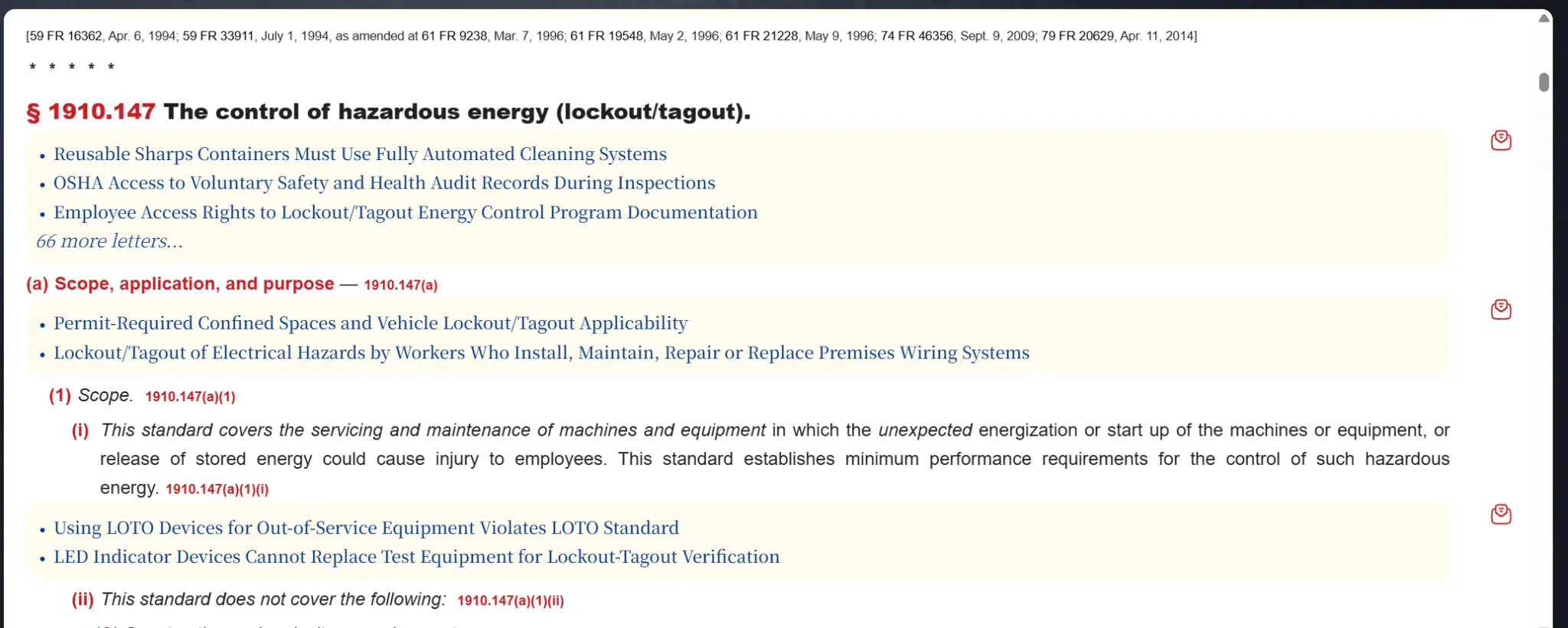
RegLogic attaches relevant LOIs directly to the regulation sections they interpret. Reading §1926.501(b)(13)? The letters defining residential construction are right there — with smart summaries that distill each letter to its operative answer and the full text one tap away. It turns the LOI corpus from a research project into a reading experience, available on both Core and Essentials plans.
Read Letters of Interpretation — searchable, color-coded, always current — in RegLogic.
Start HereFAQ
Common questions
Are Letters of Interpretation legally binding?
LOIs explain OSHA's reading of existing standards rather than creating new obligations. In practice, they carry substantial weight: they document the agency's enforcement position, and courts and review commissions consider them when interpreting a standard.
How many LOIs exist?
OSHA has issued thousands of interpretation letters across its standards since the 1970s, and continues to publish new ones. High-activity standards like fall protection, LOTO, and respiratory protection each have large families of letters.
How do I find LOIs for a specific regulation?
On OSHA.gov you search the interpretations database separately from the standard. In RegLogic, relevant letters appear attached to the exact sections they interpret, with summaries — no separate search required.
Get regulation updates that matter
Join safety pros getting enforcement trends, standard changes, and practical compliance guidance. No spam.