Standard guide · 29 CFR 1926.501
OSHA's #1 most-cited standard, fourteen years running.
29 CFR 1926.501 sets the duty to provide fall protection in construction — generally at 6 feet above a lower level. It tops OSHA's citation list every single year, with 5,914 federal violations in FY2025 alone.
What §1926.501 requires
The standard's core provision, §1926.501(b)(1), is deceptively simple: employees on a walking/working surface with an unprotected side or edge 6 feet (1.8 m) or more above a lower level must be protected by guardrail systems, safety net systems, or personal fall arrest systems. The rest of the section applies that principle to specific exposures — leading edges, hoist areas, holes, formwork, ramps, excavations, dangerous equipment, wall openings, and roofing work.
The choice among guardrails, nets, and PFAS belongs to the employer, but each system carries its own performance criteria under §1926.502 — anchorage strength, guardrail heights and loads, net placement. A harness without an adequate anchorage isn't a fall arrest system; it's a citation with extra steps.
Roofing gets special attention. On low-slope roofs, §1926.501(b)(10) permits combinations that include warning line systems and safety monitoring; on steep roofs, §1926.501(b)(11) requires guardrails with toeboards, nets, or PFAS. The definitions matter — a roof's pitch determines which paragraph governs, and inspectors check.
The residential construction question
Few provisions generate more confusion — or more Letters of Interpretation — than §1926.501(b)(13). Residential construction workers 6 feet or more above lower levels must use conventional fall protection unless the employer can demonstrate infeasibility or greater hazard, in which case a site-specific written fall protection plan under §1926.502(k) is required. Since OSHA's 2010 directive rescinded the old interim guidelines, the "residential exemption" many contractors still believe in no longer exists in the form they remember.
What counts as "residential construction"? OSHA's interpretation letters define it by construction methods and materials — wood-frame techniques — not merely by the building's use as a dwelling. Those letters attach directly to §1926.501(b)(13) in RegLogic, which is precisely the kind of context that keeps a framing contractor out of an avoidable citation.
Why citations keep piling up
Fall protection violations are the most visible in all of OSHA enforcement — a compliance officer can spot an unprotected edge from the street before the opening conference starts. Falls also remain the leading cause of construction fatalities, which keeps §1926.501 at the center of OSHA's national emphasis and local inspection programs. The result: 5,914 federal citations in FY2025, more than double the runner-up.
The companion training standard, §1926.503, ranked #7 the same year — meaning OSHA frequently cites the same employer twice on one jobsite: once for the missing protection, once for the training that would have prevented it.
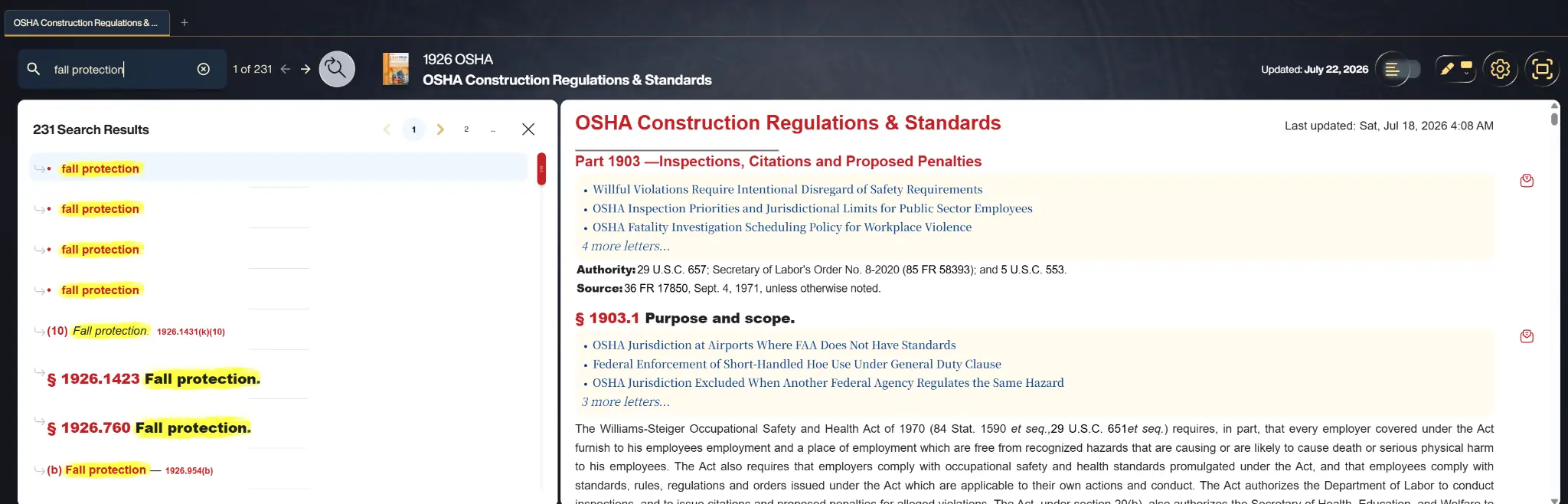
Read 29 CFR 1926.501 — color-coded, searchable, with LOIs attached — in RegLogic.
Start HereAt a glance
- General rule: fall protection required at 6 feet above a lower level in construction (§1926.501(b)(1))
- Acceptable systems: guardrails, safety nets, or personal fall arrest systems (PFAS)
- Low-slope roofs: guardrail, net, PFAS — or warning line + safety monitor combinations (§1926.501(b)(10))
- Steep roofs: guardrails with toeboards, nets, or PFAS (§1926.501(b)(11))
- Residential construction: same systems required; alternatives only with a written plan under §1926.502(k)
- Holes, skylights, and leading edges each have specific provisions
- Training required under companion standard §1926.503
FAQ
Common questions
At what height does OSHA require fall protection?
In construction, generally 6 feet above a lower level (§1926.501(b)(1)). General industry uses 4 feet (§1910.28), scaffolds trigger at 10 feet, and steel erection at 15–30 feet depending on the activity.
Is there a residential construction exemption?
No blanket exemption exists. Residential builders must use conventional systems (guardrails, nets, PFAS) unless they can demonstrate infeasibility or greater hazard and implement a written site-specific plan under §1926.502(k).
Do I need fall protection on a ladder?
Portable ladders generally don't require personal fall arrest under 1926 Subpart X, but fixed ladders over 24 feet in general industry have their own requirements under §1910.28(b)(9). Context determines the controlling standard.
What's the penalty for a fall protection violation?
For 2026, OSHA serious violations run up to roughly $16,550 each, and willful or repeated violations up to about $165,514 — per violation. Multiple exposed employees can mean multiple citations.
Get the Top 10 Violations cheat sheet
Enforcement trends, penalty amounts, and the exact paragraphs inspectors cite — straight to your inbox.
Related reading
Browse the regulation library
Every standard referenced in this guide lives in a broader regulatory framework. Explore the full library — searchable, color-coded, always current.