Standard guide · 29 CFR 1910.147
The standard that exists because machines don't know someone's inside.
29 CFR 1910.147 — the control of hazardous energy — protects workers servicing machines from unexpected startup and stored-energy release. It demands documented procedures per machine, annual audits, and role-specific training.
What the standard actually demands
LOTO compliance rests on a written energy control program with three legs: machine-specific procedures documenting how to shut down, isolate, and verify de-energization of each piece of equipment (including stored and residual energy — hydraulic, pneumatic, gravitational, thermal); periodic inspections in which an authorized employee reviews each procedure at least annually with the people who use it; and training scaled to role — authorized employees who apply locks, affected employees who work around locked-out machines, and everyone else who might wander into the area.
The famous "eight-condition exception" in §1910.147(c)(4)(i) lets employers skip written procedures only when a single energy source can be readily identified and isolated, with no stored energy and no history of accidents — conditions so narrow that most equipment fails at least one. Betting a citation contest on the exception is rarely a winning strategy.
Where LOTO programs fail
The recurring citation pattern: procedures exist for some machines but not the new line; the annual audit was skipped or documented nowhere; "minor servicing" during production is claimed for work that doesn't meet the routine-repetitive-integral test; and contractors service equipment under a program nobody coordinated. Each maps to a specific paragraph — (c)(4), (c)(6), and the minor-servicing exception's boundaries have generated decades of Letters of Interpretation.
LOTO citations also carry outsized consequences beyond the penalty schedule: hazardous-energy incidents are exactly the kind OSHA refers for willful characterization when the paperwork shows the employer knew.
LOTO in RegLogic
§1910.147 is a nested-exception minefield — the color-coded outline formatting was practically invented for it. RegLogic attaches the minor-servicing and group-lockout interpretation letters to the paragraphs they interpret, and team notes let a safety department attach its own procedure index — which written procedure covers which machine — directly to (c)(4). New maintenance hires read the rule and the plant's implementation in one sitting.
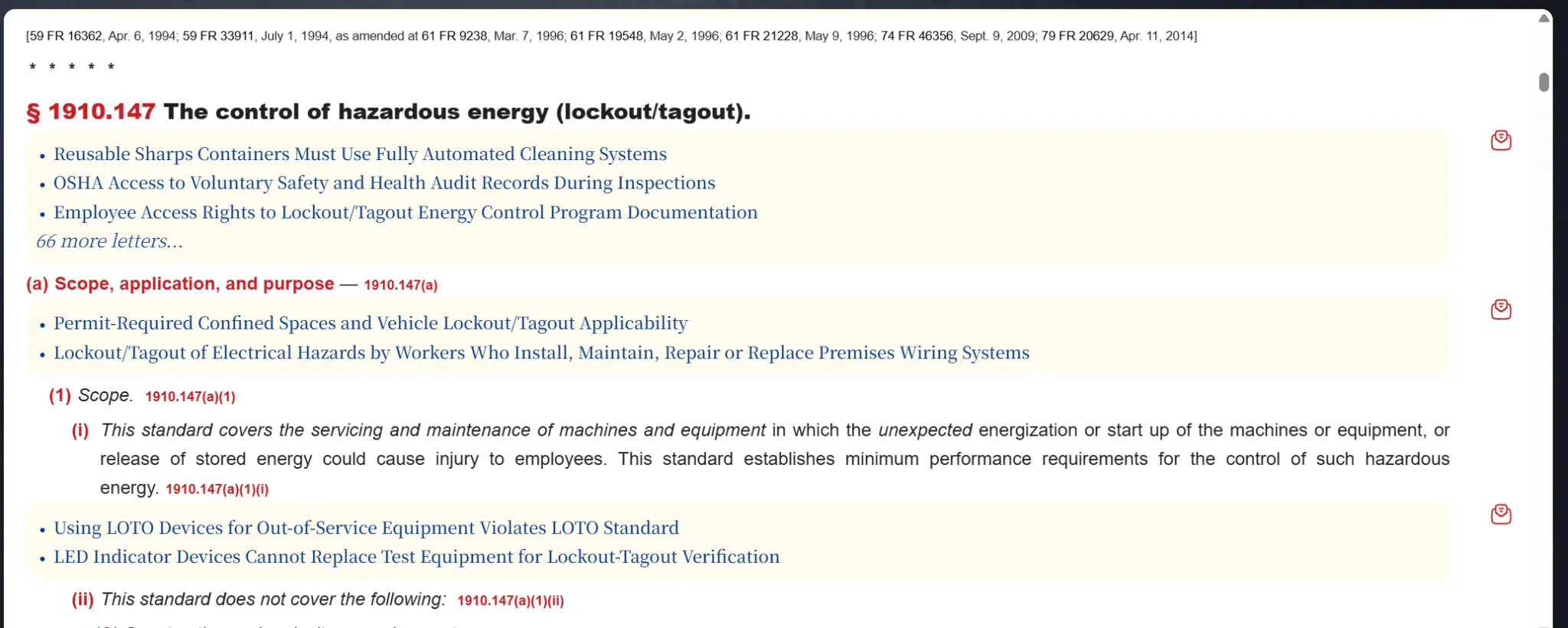
Read 29 CFR 1910.147 — color-coded, searchable, with LOIs attached — in RegLogic.
Start HereAt a glance
- Written energy control program required (§1910.147(c)(1))
- Machine-specific written procedures for servicing and maintenance (§1910.147(c)(4))
- Annual inspection of each energy control procedure (§1910.147(c)(6))
- Training tiers: authorized, affected, and other employees (§1910.147(c)(7))
- Locks and tags: standardized, durable, identifying the applier
- Group lockout and shift-change provisions for complex operations
FAQ
Common questions
Does every machine need its own written LOTO procedure?
Machines can share a procedure only when they share the same type and magnitude of energy and identical control measures. Otherwise, each needs its own — and the (c)(4)(i) exception's eight conditions rarely all hold.
What is the minor servicing exception?
Servicing during normal production operations is exempt from LOTO if it's routine, repetitive, and integral to production AND alternative effective protection is provided. It's one of the most litigated phrases in the standard — read the LOIs before relying on it.
How often must LOTO procedures be audited?
At least annually, by an authorized employee other than the one using the procedure, with a review of responsibilities for each authorized employee — and the inspection itself must be documented (§1910.147(c)(6)).
Get the Top 10 Violations cheat sheet
Enforcement trends, penalty amounts, and the exact paragraphs inspectors cite — straight to your inbox.
Related reading
Browse the regulation library
Every standard referenced in this guide lives in a broader regulatory framework. Explore the full library — searchable, color-coded, always current.